Erwin Raisz, Principles of Cartography, 1962.
Lines are foundational to how maps communicate. They guide you home from a new restaurant, tell you how tall a mountain is, and warn you not to stray too far in the wrong direction. They sometimes even tell you about the life a map has lived. Over centuries, mapmakers have developed (and abandoned) an amazing variety of ways to use lines to bring our world to life. This exhibition follows lines on maps to their extremes in examples from mundane textbooks to avant-garde art. Through these lines, maps rationalize their world view while revealing perspectives that are neither universal nor neutral.
The exhibition’s sections each delve into a fundamental kind of line on maps as they developed in Europe and the Americas. Chart your own path through the exhibition to explore how lines define—and at times subvert—the rules that make maps legible.
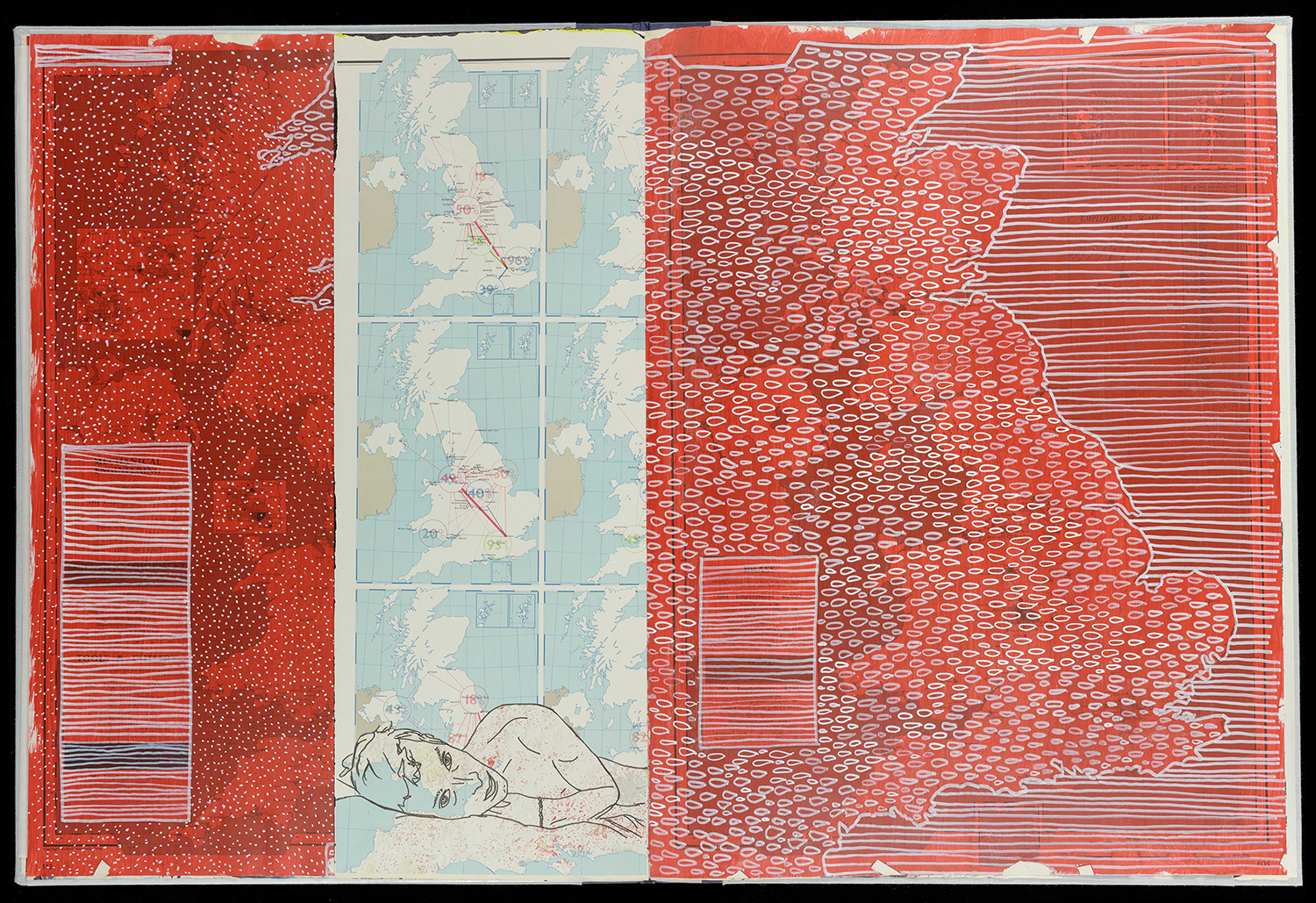
Throughout this exhibition, you will encounter artists who manipulate, deform, and even destroy maps. For the artist Michael Wynne, the lines on maps offer an expansive tool to bring together typical map elements, like borders and coasts, alongside unexpected insertions, like bodies and blood. By drawing and painting over pages of a national atlas, Wynne connects different kinds of lines—from a line-drawing of a body, to blood lines, to lines of text, to train lines—to meditate on identity, nationalism, and sexuality. Like many artists in this exhibition, Wynne alters and replaces parts of the map to critique it on its own terms.